
Aave vs Compound: Which DeFi Lending Protocol is Better?
Short answer: Neither is universally better – Aave offers more features and chains, Compound offers simplicity and deep liquidity on core assets. Most sophisticated users access both through Superlend, which aggregates 350+ money markets across 11+ chains into one dashboard.
Both protocols are battle-tested with billions in deposits. The real question isn't which one to choose – it's how to access the best rates across both at any given moment.
Overview: Aave
Aave is the largest DeFi lending protocol with $15B+ TVL across 11+ chains. That scale means deep liquidity – you can deposit and withdraw large amounts without moving markets.
Key Features
Aave introduced several innovations that have become standard in DeFi lending:
- Flash Loans: Aave pioneered flash loans – uncollateralized loans that must be borrowed and repaid within a single transaction. Developers use these for arbitrage, collateral swaps, and liquidations.
- Efficiency Mode (E-Mode): This feature allows users to maximize their borrowing power when supplying and borrowing correlated assets (like stablecoins).
- Isolation Mode: Newer or riskier assets can be listed in isolation mode, limiting their use as collateral to protect the broader protocol.
- Variable and Stable Rates: Aave offers both variable interest rates (which fluctuate based on utilization) and stable rates (which provide more predictable borrowing costs).
- Safety Module: AAVE token holders can stake their tokens in the Safety Module to backstop the protocol against shortfall events, earning rewards in return.
Chains Supported
Aave has deployed across numerous networks, including:
- Ethereum Mainnet
- Polygon
- Arbitrum
- Optimism
- Avalanche
- Base
- BNB Chain
- Fantom
- Metis
- Scroll
- zkSync Era
This multi-chain presence gives users flexibility to access Aave where gas fees are lowest or where their assets already reside.
Overview: Compound
Compound pioneered algorithmic interest rates in 2018 – a model nearly every lending protocol now uses. It's simpler than Aave with fewer features, but that simplicity means fewer decisions and a battle-tested codebase.
Key Features
Compound's approach has always emphasized simplicity and decentralization:
- cTokens: When you supply assets to Compound, you receive cTokens (like cUSDC or cETH) that represent your deposit plus accrued interest. These tokens can be transferred, used in other protocols, or redeemed for the underlying asset.
- Algorithmic Interest Rates: Compound pioneered the utilization-based interest rate model that automatically adjusts rates based on supply and demand.
- Compound III (Comet): The latest version of Compound introduces a single-borrowable-asset model with multi-collateral support, focusing on capital efficiency and risk management.
- COMP Governance: COMP token holders govern the protocol, voting on proposals that affect parameters, asset listings, and protocol upgrades.
- Transparent Liquidation: Compound's liquidation mechanism allows anyone to repay an undercollateralized loan and receive a bonus, ensuring the protocol remains solvent.
Chains Supported
Compound has a more focused multi-chain strategy:
- Ethereum Mainnet
- Polygon
- Arbitrum
- Base
- Optimism
- Scroll
While Compound supports fewer chains than Aave, it maintains deep liquidity on the networks it does support.
Compound holds several billion in deposits – smaller than Aave, but with deep liquidity on core assets like ETH and USDC.
Interest Rates Comparison
Interest rates are often the deciding factor when choosing a lending protocol. Let's examine how Aave and Compound approach rate determination.
How Each Protocol Calculates Rates
Both protocols use utilization-based interest rate models, but with some differences:
Aave's Model:
- Uses a kinked interest rate curve
- Rates stay relatively low until utilization reaches a target threshold (usually 80-90%)
- Above the threshold, rates increase sharply to encourage repayment and attract new deposits
- Offers both variable and stable rate options
Compound's Model:
- Also uses a utilization-based curve
- Compound III focuses rates around a target utilization
- Rates adjust more gradually in some configurations
- Only offers variable rates
Example Rate Comparisons
Interest rates fluctuate constantly based on market conditions.
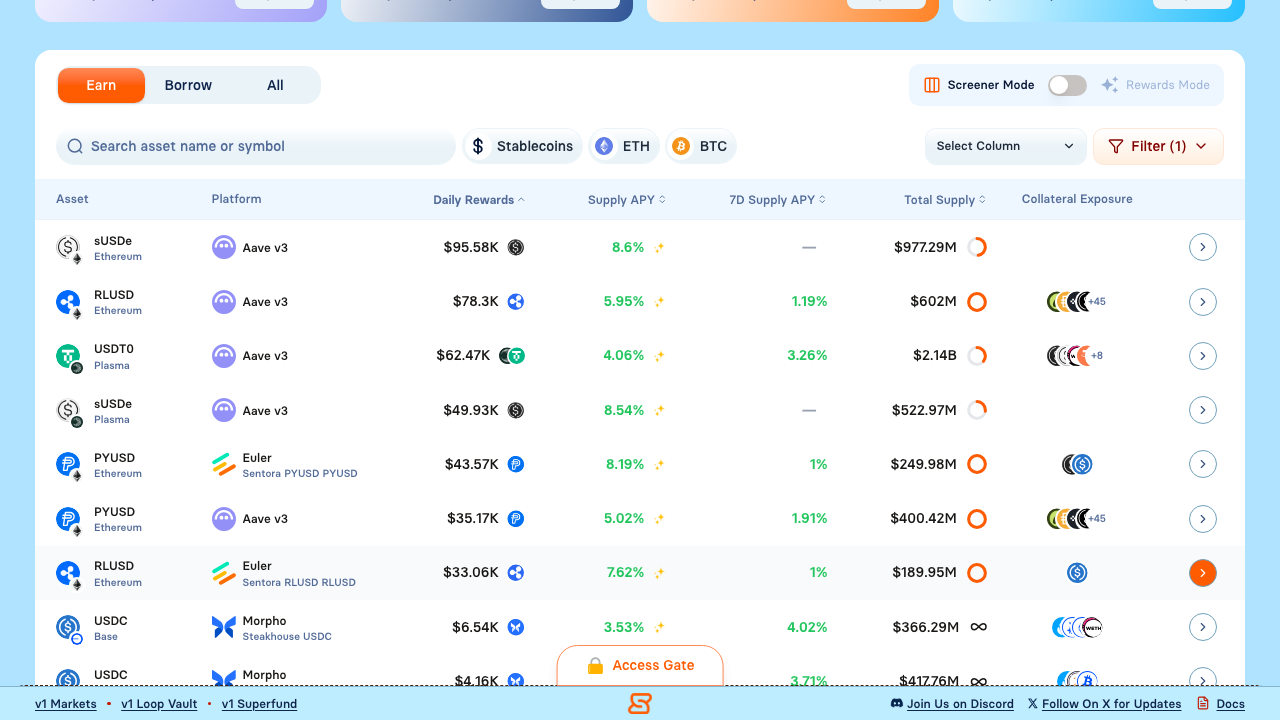 Compare lending rates across protocols on Superlend's Discover page
Note: Rates are variable and change based on market conditions. Check live rates on Superlend for current comparisons.
Rate Stability
Aave's stable rate option provides more predictable borrowing costs, though these rates are typically higher than variable rates. This can be valuable for users who need certainty in their cost of capital.
Compound's rates tend to be slightly more stable in practice due to its deeper liquidity pools on major assets, though this varies by chain and asset.
Key Takeaway
Neither protocol consistently offers better rates – it depends on the specific asset, chain, and moment in time. The best approach is to compare rates at the time you're making a decision, which is exactly what aggregators like Superlend help you do.
Supported Assets
The assets available for lending and borrowing vary between protocols and across chains.
What Each Protocol Supports
Aave typically lists more assets across its deployments:
- Major stablecoins: USDC, USDT, DAI, FRAX, GHO (Aave's native stablecoin)
- Blue-chip crypto: ETH, WBTC, LINK, UNI, AAVE
- Liquid staking tokens: stETH, rETH, cbETH
- Other DeFi tokens: CRV, BAL, MKR, SNX
- Chain-native tokens: MATIC, AVAX, OP, ARB
Compound focuses on a more curated selection:
- Core stablecoins: USDC, USDT
- Major assets: ETH, WBTC
- Select DeFi tokens: COMP, UNI, LINK
Collateral Types
Aave's isolation mode allows it to list newer assets with limited risk exposure, while Compound III's architecture centers around a single borrowable asset per market with multiple collateral options.
For users with diverse portfolios, Aave's broader asset support may be advantageous. For those focused on major assets, Compound's focused approach provides deep liquidity.
Cross-Chain Availability
Both protocols maintain different asset listings on different chains. An asset available on Ethereum may not be available on Arbitrum or Base. When planning your strategy, check the specific deployment for your target chain.
Aave supports 50+ assets across all chains including 5+ stablecoins, extensive liquid staking token (LST) support, and its native stablecoin GHO. Compound has a more focused approach with 20+ assets across all chains, 2-3 stablecoins, and limited LST support.
Security and Audits
Security is paramount in DeFi. Both Aave and Compound have strong track records, but let's examine the details.
Aave's Security Track Record
Aave has maintained an impressive security record:
- Multiple audits from top firms including OpenZeppelin, Trail of Bits, Certora, and SigmaPrime
- Formal verification of critical smart contracts
- Bug bounty program with substantial rewards
- Safety Module providing protocol-level insurance
- No major exploits of core protocol contracts
Aave also employs sophisticated risk management tools, including real-time monitoring and automated safeguards against manipulation.
Compound's Security Track Record
Compound pioneered many DeFi security practices:
- Audited by OpenZeppelin, Trail of Bits, and other leading firms
- Extensive formal verification efforts
- Active bug bounty program
- Transparent governance with timelocks on changes
- One notable incident in 2021 involved a governance bug that incorrectly distributed COMP tokens, though user funds remained safe
Both protocols benefit from years of battle-testing with billions of dollars at stake.
Insurance Options
Neither protocol provides built-in insurance for user deposits, but several options exist:
- Nexus Mutual: Offers coverage for both Aave and Compound smart contract risks
- Aave Safety Module: AAVE stakers backstop the protocol, with coverage triggered by governance vote
- InsurAce and other providers: Additional coverage options available
Risk Comparison
Both protocols have strong security profiles. Aave has been active for 6+ years with extensive audit coverage, an active bug bounty program, formal verification, and no major exploits. Compound has been active for 7+ years with similarly extensive audit coverage, bug bounty program, and formal verification. Compound experienced one governance bug in 2021 that did not result in user fund losses.
User Experience
A protocol's interface can significantly impact your efficiency and enjoyment.
Interface Comparison
Aave:
- Clean, modern interface with detailed analytics
- Dashboard shows positions across all chains
- Health factor prominently displayed
- Supports multiple wallet types
- Mobile-responsive design
Compound:
- Minimalist, straightforward interface
- Compound III introduced a refreshed design
- Clear display of borrowing capacity
- Simple supply/withdraw flow
- Focused on core functionality
Learning Curve
Compound's simpler interface may be easier for beginners – fewer options means fewer decisions. Aave's additional features (E-Mode, stable rates, isolation mode) provide more flexibility but require some learning.
For basic lending and borrowing, both protocols are intuitive. Advanced features like flash loans or E-Mode require deeper understanding.
Mobile and Desktop
Both protocols work well on desktop browsers. Mobile experience through wallet apps like MetaMask Mobile or Coinbase Wallet is functional but optimized primarily for desktop. Neither protocol has a dedicated mobile app.
UX Comparison
Aave offers a medium-complexity interface with good feature discoverability, good mobile experience, excellent transaction clarity, and a comprehensive portfolio overview. Compound takes a simpler approach with low interface complexity, excellent feature discoverability, good mobile experience, excellent transaction clarity, and a more basic portfolio overview.
Advanced Features
For power users, the advanced capabilities of each protocol may be decisive.
Aave's Advanced Features
Flash Loans: Aave's signature innovation allows developers to borrow any amount without collateral, as long as it's repaid in the same transaction. Use cases include:
- Arbitrage between exchanges
- Collateral swaps
- Self-liquidation
- Complex DeFi strategies
Efficiency Mode (E-Mode): When supplying and borrowing correlated assets (like USDC as collateral to borrow USDT), E-Mode allows up to 97% loan-to-value ratios – dramatically increasing capital efficiency.
GHO Stablecoin: Aave created GHO, a decentralized stablecoin that users can mint directly against their collateral. This provides another dimension to Aave positions.
Credit Delegation: Approved borrowers can access uncollateralized loans through credit delegation, opening DeFi to new use cases.
Compound's Advanced Features
Governance and COMP: COMP token holders have direct control over protocol parameters, asset listings, and upgrade decisions. Active governance participation earns additional COMP rewards.
Compound III Architecture: The latest version introduces a single-borrowable-asset model that simplifies risk management and can offer better rates for specific use cases.
cToken Composability: Compound's cTokens can be used in other DeFi protocols, enabling yield stacking and more complex strategies.
Reserves and Protocol Revenue: Compound accumulates reserves that provide an additional safety buffer and could fund future development or distribution to stakeholders.
When to Use Each
Both protocols are excellent – the right choice depends on your specific needs.
Choose Aave When:
- You want access to the widest selection of assets
- You need flash loans for development or arbitrage
- You prefer stable borrowing rates for predictability
- You're using liquid staking tokens as collateral
- You want to borrow correlated assets with maximum efficiency (E-Mode)
- You need to operate across many different chains
Choose Compound When:
- You prioritize simplicity and ease of use
- You want deep liquidity on core assets (ETH, USDC)
- You're interested in governance participation
- You prefer a more conservative, battle-tested approach
- You want composable cTokens for other DeFi strategies
- You're focused on Ethereum or a few specific L2s
The Reality
Many sophisticated DeFi users don't choose – they use both, along with other protocols, based on where rates are best at any given moment. The market is dynamic, and yesterday's best rate might not be today's.
Why Not Choose? Use Superlend
Here's the truth: obsessing over Aave vs Compound might be the wrong framing altogether.
Both protocols are excellent. Both are secure. Both offer competitive rates. The real question isn't which one is better – it's how to access the best opportunities across both, plus the hundreds of other lending markets available in DeFi.
That's exactly what Superlend helps you do.
One Dashboard for All Your DeFi Lending: Instead of manually checking rates on Aave, Compound, and dozens of other protocols, Superlend aggregates 350+ money markets across 11+ chains. See where your USDC earns the highest yield. Compare borrowing costs across protocols. Execute transactions without hopping between different interfaces.
Real-Time Rate Comparison: Rates change constantly. Superlend shows you current rates across all major protocols, so you can make informed decisions based on live data – not yesterday's snapshot.
Simplified Multi-Protocol Management: Track your positions across Aave, Compound, and other protocols from one place. No more juggling tabs or losing track of where your funds are deployed.
The debate between Aave and Compound is useful for understanding the landscape. But in practice, the best DeFi users access both – and Superlend makes that effortless.
Explore 350+ lending markets on Superlend
Frequently Asked Questions
Is Aave or Compound safer?
Both protocols have excellent security track records and have been audited extensively. Aave has never experienced a protocol-level exploit. Compound had one governance bug in 2021 that didn't result in loss of user funds. Both protocols benefit from years of battle-testing with billions of dollars. Your choice shouldn't hinge primarily on security – both are industry leaders.
Which protocol has better interest rates?
Neither consistently offers better rates. Interest rates depend on utilization, which varies by asset, chain, and market conditions. On any given day, Aave might have better USDC rates while Compound offers better ETH rates. The best approach is to compare rates at the time you're making decisions using an aggregator like Superlend.
Can I use both Aave and Compound at the same time?
Absolutely. Many DeFi users supply assets to both protocols based on where rates are most attractive. You can also borrow from one and supply to another if you find favorable rate differentials. Aggregators like Superlend make managing positions across multiple protocols simple.
Which protocol is better for beginners?
Compound's simpler interface and fewer options make it slightly more approachable for beginners. However, Aave's interface is also well-designed and intuitive for basic operations. Either protocol is suitable for beginners – the fundamentals of supplying and borrowing are similar. Start with small amounts to get comfortable before deploying significant capital.
Conclusion
Aave and Compound are both pillars of DeFi lending. Aave offers more features, chains, and asset variety. Compound provides elegant simplicity and deep liquidity on core assets. Neither is universally "better" – the right choice depends on your specific needs, the assets you're working with, and your comfort level with complexity.
For most users, the ideal approach isn't choosing one forever – it's having the flexibility to use both, and access other protocols too. That's the power of DeFi: open, permissionless markets competing for your capital. For a broader understanding of the space, check out our complete guide to DeFi lending or explore specific assets like ETH lending rates and WBTC lending.
Ready to compare rates across Aave, Compound, and 350+ other markets? Start exploring with Superlend.
This article is for educational purposes only and does not constitute financial advice. DeFi involves risks including smart contract vulnerabilities and potential loss of funds. Rates are variable and subject to change. Past performance does not guarantee future results. Always conduct your own research before making investment decisions.