
If you're holding Bitcoin and watching stablecoin lenders earn passive income, you might be wondering – is there a way to put your BTC to work without selling it? The answer is yes, and it's called WBTC lending.
For long-term Bitcoin believers, selling isn't an option. You've held through bear markets, accumulating on dips, and you're not about to give up your position for a few percentage points of yield. But what if you could keep your Bitcoin exposure and still generate returns?
That's exactly what WBTC lending offers. By converting your BTC to Wrapped Bitcoin (WBTC) and supplying it to DeFi lending protocols, you can earn yield while maintaining your exposure to Bitcoin's price movements. It's not as high-yielding as stablecoin lending – typically ranging from 0.5% to 4% APY – but for those who want their Bitcoin working for them, it's an attractive option.
WBTC lending typically yields 0.5-4% APY – modest compared to stablecoins, but valuable for Bitcoin holders who want their BTC working without selling. Here's what you need to know about rates, risks, and getting started.
What is WBTC?
Wrapped Bitcoin (WBTC) is an ERC-20 token that represents Bitcoin on the Ethereum blockchain. Each WBTC token is backed 1:1 by real Bitcoin held in reserve, meaning one WBTC always equals one BTC in value.
Why Does WBTC Exist?
Bitcoin's blockchain is powerful, but it operates separately from Ethereum and its vast DeFi ecosystem. WBTC solves this by creating a bridge – it lets Bitcoin holders access Ethereum-based applications like lending protocols, decentralized exchanges, and yield farming opportunities without actually selling their BTC.
How Wrapping Works
The wrapping process involves a network of custodians and merchants:
- Custodians (like BitGo) hold the actual Bitcoin in secure, multi-signature wallets
- Merchants facilitate the minting and burning of WBTC tokens
- When you wrap BTC, the Bitcoin is deposited with a custodian, and an equivalent amount of WBTC is minted on Ethereum
- When you unwrap, the WBTC is burned and BTC is released back to you
All reserves are publicly verifiable. You can check the WBTC dashboard at any time to confirm that every WBTC token is backed by real Bitcoin. This transparency is crucial – it's what gives WBTC its value as a Bitcoin-pegged asset on Ethereum.
It's worth noting that WBTC is a custodial solution, meaning you're trusting the custodian network to hold your Bitcoin safely. This is different from holding BTC directly in your own wallet, and it's one of the key risks we'll discuss later.
How WBTC Lending Works
Lending WBTC follows the same mechanics as lending any other asset in DeFi – you supply your tokens to a liquidity pool, borrowers pay interest to access those funds, and you earn a share of that interest.
The Lending Process
- Supply WBTC – You deposit your WBTC into a lending protocol like Aave, Compound, or Morpho
- Borrowers Access Liquidity – Traders and other DeFi users borrow your WBTC, typically posting collateral worth more than what they borrow (overcollateralization)
- Earn Interest – As borrowers repay their loans with interest, you earn a portion of those payments proportional to your share of the pool
- Withdraw Anytime – Most protocols allow you to withdraw your WBTC plus accumulated interest whenever you want (subject to pool utilization)
Why Borrow WBTC?
Understanding who borrows WBTC helps explain the demand (and therefore the rates). Common borrowers include:
- Short sellers – Traders who want to bet against Bitcoin borrow WBTC to sell, hoping to buy it back cheaper later
- Arbitrageurs – Market makers who need WBTC for cross-platform trading strategies
- DeFi strategists – Users who deploy WBTC in yield farming or liquidity provision strategies
Maintaining Your BTC Exposure
Here's the key advantage: while you're earning yield, your position still tracks Bitcoin's price. If BTC goes up 20%, your WBTC position goes up 20% too – plus the interest you've earned. You're not sitting in stablecoins missing out on potential gains.
Of course, this works both ways. If Bitcoin drops, your position drops with it. But for long-term holders, this isn't a bug – it's a feature. You wanted BTC exposure, and you've got it.
Current WBTC Lending Rates
Let's talk numbers. WBTC lending rates are typically lower than stablecoin rates – and there's a good reason for this.
Why WBTC Rates Are Lower
Stablecoins like USDC and USDT see massive borrowing demand. People borrow stables to buy more crypto, to pay bills, or to access liquidity without selling their holdings. WBTC borrowing demand is more limited – primarily short sellers and arbitrageurs.
Lower demand means lower rates. While stablecoins might offer 5-15% APY on lending protocols, WBTC typically ranges from 0.5% to 4% APY, depending on the protocol and market conditions.
Current Rates by Protocol
WBTC lending rates vary by protocol and chain. Rather than listing static numbers that quickly become outdated, you can view current rates across all protocols on Superlend's Discover page – just filter by BTC to see all Bitcoin-related lending opportunities.
What Drives Rate Fluctuations?
WBTC lending rates spike during specific market conditions:
- Market volatility – When Bitcoin makes big moves, short selling activity increases, pushing up borrowing demand
- Bull market corrections – Traders betting on pullbacks borrow WBTC to short, creating temporary rate spikes
- DeFi seasons – High activity in DeFi can increase demand for WBTC across various strategies
During calm markets, rates tend to hover at the lower end. During volatile periods, you might see rates temporarily jump to 4% or higher.
Best Protocols for WBTC Lending
Not all lending protocols are created equal. Here's a breakdown of the top options for WBTC lenders.
Aave
Aave is the largest lending protocol in DeFi, with billions in total value locked. For WBTC lending, it offers:
- Deep liquidity – Large pools mean you can deposit and withdraw significant amounts without impacting rates
- Multi-chain presence – Lend WBTC on Ethereum, Arbitrum, Base, Optimism, and more
- Battle-tested security – Years of operation with multiple audits and a strong security track record
- Typical APY: 0.8% – 2.5%
Compound
Compound pioneered the lending protocol model and remains a reliable choice:
- Simple interface – Straightforward deposit and withdrawal process
- Conservative risk parameters – Prioritizes safety over maximizing rates
- Established reputation – One of the oldest and most trusted DeFi protocols
- Typical APY: 0.5% – 2.0%
Morpho
Morpho optimizes lending by directly matching lenders with borrowers when possible:
- Improved rates – Peer-to-peer matching can offer better APY than pooled lending
- Built on Aave/Compound – Uses established protocols as a fallback, combining innovation with security
- Capital efficiency – Better utilization of your supplied assets
- Typical APY: 1.0% – 3.5%
Choosing the Right Protocol
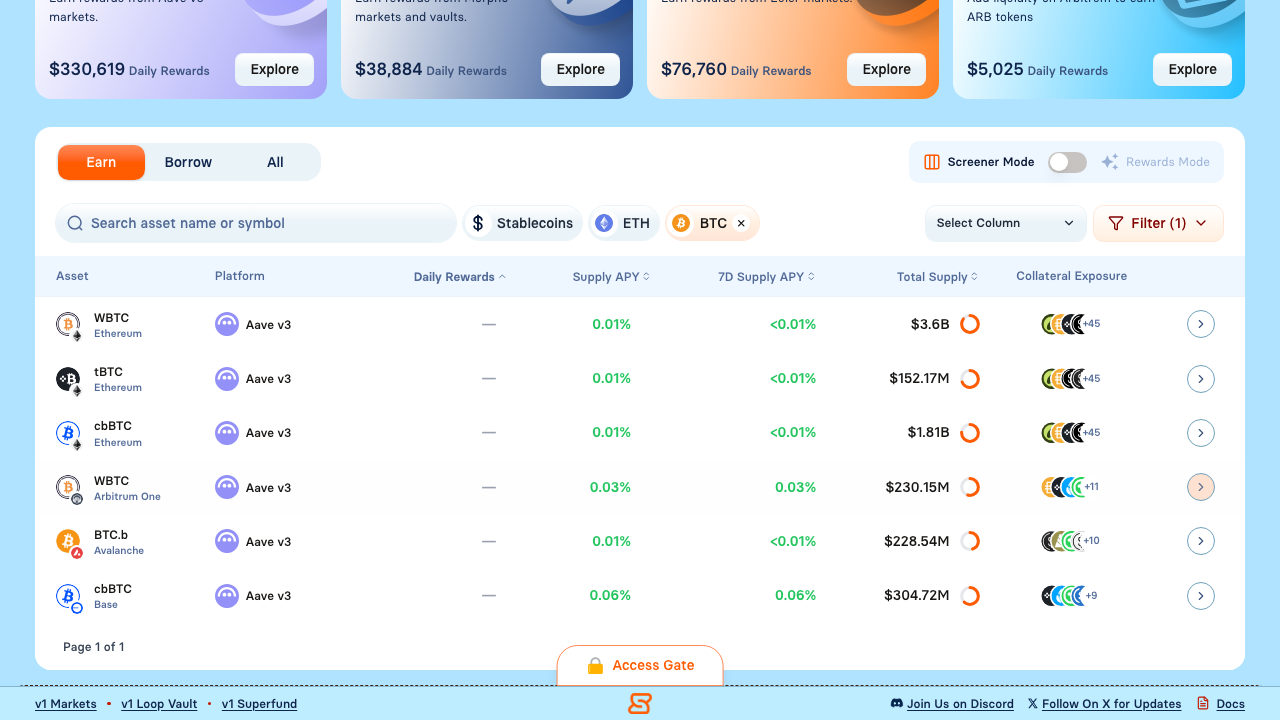 Compare WBTC lending rates across protocols on Superlend
For most users, Aave offers the best balance of liquidity, rates, and security. If you're comfortable with a slightly newer protocol and want to optimize for yield, Morpho is worth considering. For a detailed breakdown of the two largest protocols, read our Aave vs Compound comparison.
Risks of WBTC Lending
WBTC lending isn't risk-free. Understanding these risks is essential before you deposit any funds.
WBTC Custodial Risk
Unlike holding Bitcoin in your own wallet, WBTC requires trusting custodians – primarily BitGo – to hold the underlying BTC. If the custodian were compromised, experienced fraud, or faced regulatory action, WBTC holders could be affected.
Mitigation: Monitor WBTC reserve proofs regularly. Diversify across different wrapped Bitcoin options if you're holding significant amounts.
Smart Contract Risk
Lending protocols are software, and software can have bugs. Despite extensive audits, there's always a non-zero chance of a smart contract vulnerability being exploited.
Mitigation: Stick to battle-tested protocols like Aave and Compound. Check audit reports and protocol history. Consider using Superlend to access these protocols with additional safeguards.
Price Volatility
Your WBTC position tracks Bitcoin's price. If BTC drops 30%, your lent position drops 30% too – regardless of the interest you've earned. A 2% APY doesn't mean much if you lose 30% on the underlying asset.
Mitigation: Only lend WBTC if you're a long-term Bitcoin holder comfortable with price volatility. Don't lend more than you'd be willing to hold as spot BTC.
Liquidity Risk
In extreme market conditions, withdrawal liquidity can be constrained. If utilization is very high (most of the pool is borrowed), you might not be able to withdraw immediately.
Mitigation: Monitor pool utilization rates. Major protocols like Aave rarely see utilization above 80%, but smaller pools or volatile markets can spike higher.
Evaluating Overall Risk
WBTC lending on established protocols is relatively low-risk by DeFi standards. The main risks are the custodial nature of WBTC itself and general smart contract exposure. For Bitcoin holders already comfortable with crypto risk, adding lending protocol risk is incremental – but it's still risk. Never lend more than you can afford to lose.
Getting Started with WBTC Lending on Superlend
Ready to start earning yield on your Bitcoin? Superlend makes it easy to compare rates across protocols and start lending in minutes.
Step-by-Step Guide
- Visit app.superlend.xyz – Connect your wallet (MetaMask, WalletConnect, or other supported wallets)
- Navigate to Lend/Earn – Browse available WBTC opportunities across chains
- Compare rates – Superlend aggregates rates from Aave, Compound, Morpho, and 350+ other markets so you can find the best yield
- Select a position – Choose the protocol and chain that fits your risk tolerance and yield goals
- Deposit WBTC – Approve the transaction and supply your WBTC to start earning immediately
Don't have WBTC yet? You can wrap BTC through various bridges or swap for WBTC on decentralized exchanges. Superlend shows you where to find the best rates for your wrapped Bitcoin once you're ready.
For a deeper understanding of how DeFi lending works, check out our complete guide to DeFi lending. If you're also interested in lending ETH, see our breakdown of ETH lending rates. Want to understand protocol safety? Read Is DeFi lending safe?
Frequently Asked Questions
Is WBTC the same as Bitcoin?
WBTC is a 1:1 representation of Bitcoin on the Ethereum blockchain. Its price tracks BTC exactly, but it's an ERC-20 token rather than native Bitcoin. This means you need to trust the custodians holding the underlying BTC reserves.
Can I lose my Bitcoin from lending WBTC?
You won't lose your WBTC from normal lending operations – protocols use overcollateralization to protect lenders. However, smart contract exploits or custodian failures (though rare) could result in losses. Only use established protocols and never lend more than you can afford to lose.
Why are WBTC rates lower than stablecoin rates?
Borrowing demand for WBTC is lower than for stablecoins. Fewer people want to borrow Bitcoin compared to stables, which means less competition driving up rates. However, WBTC rates can spike during volatile markets when short-selling activity increases.
Conclusion
WBTC lending offers Bitcoin holders a way to generate passive income without giving up their BTC exposure. While rates are modest compared to stablecoin lending – typically 0.5% to 4% APY – it's an attractive option for those who want their Bitcoin working for them during holding periods.
The key is understanding the tradeoffs: you're adding smart contract risk and custodial risk in exchange for yield. For long-term Bitcoin holders comfortable with these factors, WBTC lending can be a sensible addition to a DeFi strategy.
Start comparing WBTC lending rates across 350+ markets at app.superlend.xyz.
Disclaimer: This article is for informational purposes only and is not financial advice. DeFi involves risks including smart contract vulnerabilities, custodial risk, and price volatility. Rates are variable and subject to change. Always do your own research and only invest what you can afford to lose.