
Morpho is a DeFi lending protocol built on Morpho Blue, a permissionless lending primitive that enables highly efficient, isolated lending markets. Users can expect yields ranging from 3-8% APY on stablecoins like USDC and USDT through curated Morpho Vaults that optimize capital allocation across multiple markets.
What is Morpho?
Morpho is a modular lending protocol built around Morpho Blue – a minimal, immutable lending primitive that serves as the foundation for permissionless lending markets. Unlike traditional lending protocols with predetermined parameters, Morpho Blue allows anyone to create isolated lending markets with custom collateral, oracles, and risk parameters.
Morpho Blue is permissionless lending infrastructure that enables isolated markets with any collateral pair, oracle, and loan-to-value ratio.
The protocol operates on Ethereum mainnet and Base, with the ecosystem organized into two layers:
- Morpho Blue: The base layer – a trustless, efficient lending primitive
- Morpho Vaults: Curated strategies built on top of Morpho Blue, managed by professional risk curators
This architecture separates the lending infrastructure (Morpho Blue) from risk management (Morpho Vaults), allowing users to choose their preferred level of complexity and curation.
The protocol has grown substantially since its launch, with billions in total value locked across its various markets and vaults. This growth reflects demand for more capital-efficient lending with flexible risk parameters.
How Morpho Blue Works
Morpho Blue takes a fundamentally different approach from protocols like Aave and Compound. Instead of pooling all assets together with protocol-defined parameters, Morpho Blue enables isolated lending markets – each with its own collateral type, oracle, and risk settings.
Each Morpho Blue market is defined by five parameters:
- Loan token: The asset being lent (e.g., USDC)
- Collateral token: The asset used as collateral (e.g., wstETH)
- Oracle: The price feed used for liquidations
- Liquidation LTV (LLTV): The loan-to-value ratio triggering liquidations
- Interest Rate Model (IRM): How rates adjust based on utilization
This isolated design means that risk is contained to individual markets. A problem with one collateral type doesn't affect unrelated markets – unlike pooled protocols where all assets share risk exposure.
The minimalist design of Morpho Blue also means lower gas costs. With fewer parameters and simpler logic, transactions cost less than on more complex protocols.
For lenders, Morpho Blue offers direct access to specific markets. You can choose exactly which collateral types you're comfortable with and which oracles you trust. This granular control comes with the tradeoff of requiring more active management compared to pooled protocols.
Morpho Vaults Explained
Morpho Vaults represent the next evolution of the protocol, offering curated lending strategies managed by professional risk teams. Rather than depositing directly into single markets, vault depositors gain exposure to optimized, diversified lending positions.
What Are Morpho Vaults?
Morpho Vaults are ERC-4626 compliant smart contracts that accept deposits and allocate capital across multiple Morpho markets according to a predefined strategy. Each vault has a designated curator responsible for setting allocation parameters, risk limits, and rebalancing positions.
The vault structure provides several advantages:
- Professional risk management: Expert curators analyze markets and manage allocations
- Diversification: Capital spreads across multiple markets and collateral types
- Automation: Rebalancing happens automatically without user intervention
- Gas efficiency: Single deposit transaction provides exposure to many markets
Major Vault Curators
Gauntlet operates several prominent Morpho vaults focused on risk-adjusted returns. Their USDC vault targets blue-chip collateral types like ETH and wstETH, maintaining conservative loan-to-value ratios. Gauntlet's quantitative approach to risk management has made their vaults popular among institutional depositors seeking predictable yields with managed risk exposure.
Steakhouse Financial brings traditional finance expertise to DeFi vault management. Their vaults often incorporate real-world asset (RWA) exposure alongside crypto-native positions. Steakhouse vaults typically target slightly higher yields by accepting collateral types that other curators avoid, while still maintaining professional risk standards.
RE7 Capital focuses on yield optimization across the Morpho ecosystem. Their vault strategies often pursue higher APY targets by accepting a broader range of collateral types and managing positions actively based on market conditions.
MEV Capital specializes in vaults that capitalize on market inefficiencies. Their strategies may involve more active management and shorter-duration positions compared to other curators.
Choosing a Vault
When selecting a Morpho vault, consider these factors:
- Target APY: Higher targets typically mean accepting more risk
- Collateral types: Some vaults only accept ETH/LST collateral, others include more exotic assets
- Curator track record: Review historical performance and risk management practices
- Minimum deposits: Some vaults target institutional capital with higher minimums
- Lock-up periods: Most vaults allow instant withdrawals, but some may have delays
Superlend, a non-custodial DeFi lending aggregator, displays real-time vault data including APY, TVL, curator information, and collateral composition –making comparison straightforward.
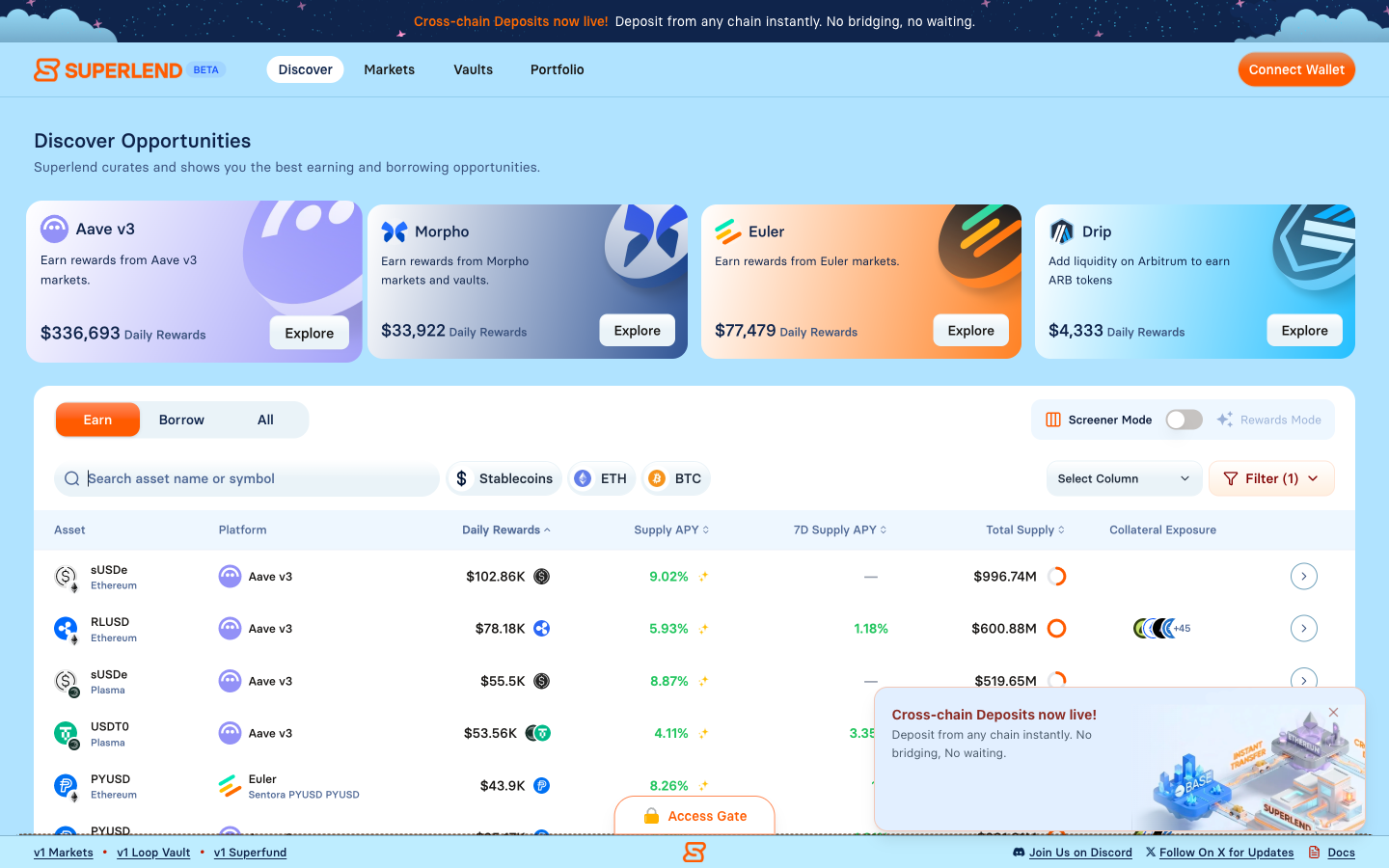 Morpho lending opportunities across markets on Superlend.
Current Morpho Rates
Morpho rates fluctuate based on market conditions, matching efficiency, and vault strategy. The following ranges represent typical yields observed across different asset types and strategies.
Stablecoin Yields
USDC: 3.5-6% APY base, with optimized vaults reaching 5-8% APY during favorable conditions. Conservative vaults accepting only ETH and major LST collateral cluster around 3.5-5% APY.
USDT: 3-5.5% APY base, similar optimization potential as USDC. Slightly lower demand typically results in marginally lower rates.
DAI: 3-5% APY, with some variation based on MakerDAO's own rate policies affecting broader market dynamics.
ETH and LST Yields
ETH: 1-3% APY when supplied as collateral in borrowing positions. Native ETH lending rates remain compressed due to staking alternatives.
wstETH: 0.5-2% APY additional yield on top of staking returns when used in Morpho markets. Popular as collateral for stablecoin borrowing.
cbETH: Similar profile to wstETH, with rates varying based on Coinbase staking dynamics.
Factors Affecting Rates
Several factors influence Morpho yields:
- Matching efficiency: Higher matching percentages improve rates
- Market utilization: More borrowing demand means better lender rates
- Vault strategy: Aggressive vaults target higher yields with more risk
- Network conditions: Gas costs and congestion affect rebalancing efficiency
- Broader DeFi rates: Morpho rates track general market conditions
You can monitor current rates across all Morpho markets through Superlend's discovery page, which aggregates real-time data from multiple protocols including Morpho.
How to Use Morpho Through Superlend
Superlend functions as a non-custodial DeFi lending aggregator, providing a unified interface to access Morpho alongside other major lending protocols. Using Morpho through Superlend offers several practical advantages.
Benefits of Using Superlend
Rate comparison: View Morpho rates alongside Aave, Compound, and other protocols in a single interface. This comparison helps identify the best opportunity for your specific asset and risk tolerance.
Vault aggregation: Access all Morpho vaults from different curators without navigating multiple interfaces. Filter by asset type, APY, curator, or risk profile.
Position management: Track your Morpho positions alongside holdings on other protocols. Unified dashboards simplify portfolio management across DeFi.
Network support: Superlend supports Morpho deployments on both Ethereum mainnet and Base, allowing you to choose based on gas costs and liquidity preferences.
Step-by-Step Process
- Connect your wallet to Superlend at app.superlend.xyz
- Navigate to Vaults to view available Morpho vault options
- Filter and compare vaults by asset type, APY, and curator
- Select a vault that matches your yield targets and risk tolerance
- Approve and deposit your assets directly through the interface
- Monitor performance through Superlend's portfolio dashboard
The entire process remains non-custodial –your assets flow directly to Morpho smart contracts without Superlend holding funds at any point. You maintain full control and can withdraw directly from Morpho if preferred.
Optimizing Your Strategy
Effective Morpho usage often involves:
- Splitting deposits across multiple vaults to diversify curator risk
- Monitoring matching rates to assess optimization efficiency
- Rebalancing periodically as market conditions change vault performance
- Comparing with alternatives to ensure Morpho remains competitive
For a deeper understanding of lending fundamentals, review our complete guide to DeFi lending.
Risks and Considerations
Understanding Morpho's risk profile requires examining multiple dimensions. While the protocol has operated without major incidents, DeFi lending carries inherent risks that users must evaluate.
Smart Contract Risk
Morpho's contracts have undergone multiple audits by firms including Spearbit, Trail of Bits, and others. The protocol's modular architecture limits the blast radius of potential vulnerabilities, but smart contract risk can never be fully eliminated. The vault layer adds additional contract surface area that users should consider.
Curator Risk
When using Morpho Vaults, you're trusting a curator to manage risk appropriately. Curators set parameters like acceptable collateral types, loan-to-value ratios, and allocation limits. Poor judgment by a curator could result in losses, even if the underlying Morpho contracts function correctly.
Different curators have different risk philosophies. Conservative curators may sacrifice yield for safety, while aggressive curators pursue higher returns with increased exposure to volatile or exotic collateral types.
Collateral Risk
Morpho markets accept various collateral types, each with distinct risk profiles. ETH and major LSTs represent relatively stable collateral. More exotic assets –wrapped tokens, governance tokens, or newly launched assets –carry higher volatility and potential for rapid depegging.
Vaults that accept diverse collateral types offer higher yields precisely because they accept this additional risk. Understand what collateral backs your lending positions before depositing.
Liquidity Risk
While most Morpho vaults allow instant withdrawals, liquidity constraints can emerge during market stress. If borrowing demand spikes and all deposited capital becomes utilized, withdrawals may face delays until borrowers repay or new deposits arrive.
Some vault strategies involve longer-duration positions that may not be immediately liquid. Review vault documentation for any withdrawal restrictions or delays.
Market Risk
DeFi lending rates respond to market conditions. Bear markets often see compressed yields as borrowing demand drops. Morpho Vault returns also compress when fewer borrowers seek leverage, as utilization across markets decreases.
For detailed analysis of lending safety considerations, read our guide on DeFi lending safety.
FAQ
How does Morpho compare to Aave or Compound for stablecoin lending?
Morpho often offers improved rates over Aave and Compound through its isolated market design and professional vault curation. Morpho Vaults allocate capital across multiple Morpho Blue markets, optimizing for yield while managing risk through diversification. The improvement varies based on market conditions and vault strategy, but well-managed vaults often achieve 0.5-2% higher APY than base Aave or Compound rates. For a detailed comparison of stablecoin lending options, see our USDC lending guide.
What happens to my funds if a Morpho vault curator makes poor decisions?
Your funds remain in Morpho smart contracts, not under curator control. Curators set parameters and allocation targets, but they cannot withdraw user funds. However, poor parameter choices –like accepting risky collateral or setting aggressive loan-to-value ratios –could result in losses if borrowers default and collateral proves insufficient. Choosing established curators with strong track records reduces this risk. Diversifying across multiple curators provides additional protection.
Can I withdraw from Morpho at any time?
Most Morpho positions and vaults allow instant withdrawals, but constraints can apply. If utilization reaches 100% (all deposited assets are borrowed), you may need to wait for repayments or new deposits before withdrawing. Some specialized vault strategies may have explicit withdrawal delays or notice periods. Check specific vault terms before depositing. During normal market conditions, stablecoin withdrawals typically process immediately.
Conclusion
Morpho represents a meaningful advancement in DeFi lending efficiency. By matching lenders and borrowers directly, the protocol captures value that traditional pool-based lending leaves on the table. The vault ecosystem adds professional curation to this foundation, offering users access to sophisticated yield strategies without requiring deep DeFi expertise.
The protocol's track record demonstrates the viability of optimized lending approaches. Users seeking improved stablecoin yields or efficient borrowing rates should consider Morpho as part of their DeFi strategy.
Using a non-custodial DeFi lending aggregator like Superlend simplifies access to Morpho alongside other protocols, enabling informed comparison and efficient position management. Start by exploring available vaults at Superlend's vault page or compare rates across protocols on the discovery page.
This content is for informational purposes only and does not constitute financial advice. DeFi protocols carry risks including smart contract vulnerabilities, market volatility, and potential loss of funds. Always conduct your own research and consider your risk tolerance before participating in DeFi lending.