
rETH is Rocket Pool's liquid staking token that represents staked ETH plus accumulated staking rewards, currently earning approximately 3-4% APY from Ethereum's proof-of-stake consensus. By deploying rETH into DeFi lending protocols, holders can stack additional yield on top of base staking returns, potentially reaching 5-8% combined APY depending on market conditions.
What is rETH?
rETH (Rocket Pool ETH) is the liquid staking derivative issued by Rocket Pool, the largest decentralized Ethereum staking protocol. When users deposit ETH into Rocket Pool, they receive rETH tokens that represent their staked ETH plus a proportional share of staking rewards.
Unlike rebasing tokens that increase in quantity, rETH uses a value-accruing model. The token's exchange rate against ETH increases over time as staking rewards accumulate. One rETH today might be worth 1.10 ETH, while in a year it could be worth 1.14 ETH, reflecting the earned rewards.
Rocket Pool achieves decentralization through its permissionless node operator network. Anyone with 8 ETH (or 16 ETH for standard minipools) can run a Rocket Pool node, creating a distributed validator set rather than relying on a single centralized operator. This structure makes rETH one of the most decentralized liquid staking options available.
Key characteristics of rETH include:
- Value-accruing mechanism: Exchange rate increases as rewards accumulate
- Decentralized infrastructure: Thousands of independent node operators
- Permissionless staking: No minimum deposit requirements for liquid stakers
- Instant liquidity: Trade on DEXs without waiting for unstaking periods
- Ethereum-native: No cross-chain bridges required for core functionality
The protocol maintains a balance between decentralization and capital efficiency through its unique minipool design, where node operators contribute a portion of each validator's stake while protocol depositors supply the remainder.
rETH vs Other LSTs
The liquid staking market offers several options, each with distinct characteristics. Understanding these differences helps users select the right token for their needs.
rETH vs wstETH
Lido's wstETH dominates liquid staking by market share, but rETH offers advantages in decentralization. Lido operates with a curated set of approximately 30 professional node operators, while Rocket Pool supports thousands of permissionless operators globally.
wstETH typically offers slightly higher base yields (0.1-0.3% more) due to Lido's economies of scale and lower overhead. However, Rocket Pool users accept this tradeoff for reduced centralization risk and censorship resistance.
Both tokens use value-accruing models, making them functionally similar for DeFi integrations. Protocol choice often comes down to prioritizing yield optimization versus decentralization principles.
rETH vs cbETH
Coinbase's cbETH represents the centralized exchange approach to liquid staking. While convenient for Coinbase users, cbETH carries custodial risk since Coinbase controls the underlying staked ETH.
rETH provides non-custodial exposure to staking rewards. Users maintain sovereignty over their tokens, and the underlying ETH is distributed across independent node operators rather than held by a single entity.
cbETH may face regulatory pressure that decentralized alternatives avoid. For users prioritizing self-custody and regulatory independence, rETH presents a stronger option.
Decentralization Advantages
Rocket Pool's decentralized architecture provides several tangible benefits:
- Censorship resistance: No single point of failure or control
- Geographic distribution: Node operators span multiple jurisdictions
- Protocol resilience: Individual operator issues don't affect the entire network
- Credible neutrality: No corporate entity can be pressured to censor transactions
These properties matter increasingly as regulatory scrutiny of staking services intensifies globally.
Current rETH Opportunities
The rETH lending market differs from standard ETH markets. Most protocols accept rETH primarily as collateral rather than offering direct supply yields on the token itself.
Collateral-Focused Markets
Major lending protocols including Aave, Compound, and Spark support rETH as collateral. Users can deposit rETH to borrow stablecoins or other assets while continuing to earn underlying staking rewards.
This collateral utility creates value even without direct lending yield. Holders access liquidity without selling their position, and staking rewards continue accumulating regardless of the collateral status.
Limited Direct Supply Yield
Direct rETH supply markets remain less common than ETH or stablecoin markets. When available, supply APYs tend to be modest (0.5-2%) due to limited borrowing demand for the token itself.
Borrowers typically seek rETH for arbitrage or hedging strategies rather than operational needs, creating less consistent demand compared to stablecoins. Users seeking direct lending income may find better opportunities by converting to ETH or using rETH as collateral to borrow assets they can then supply elsewhere.
Protocol Support
Check Superlend's discover page to find current rETH markets across multiple protocols and chains. Superlend operates as a non-custodial DeFi lending aggregator, surfacing opportunities across protocols without taking custody of user funds.
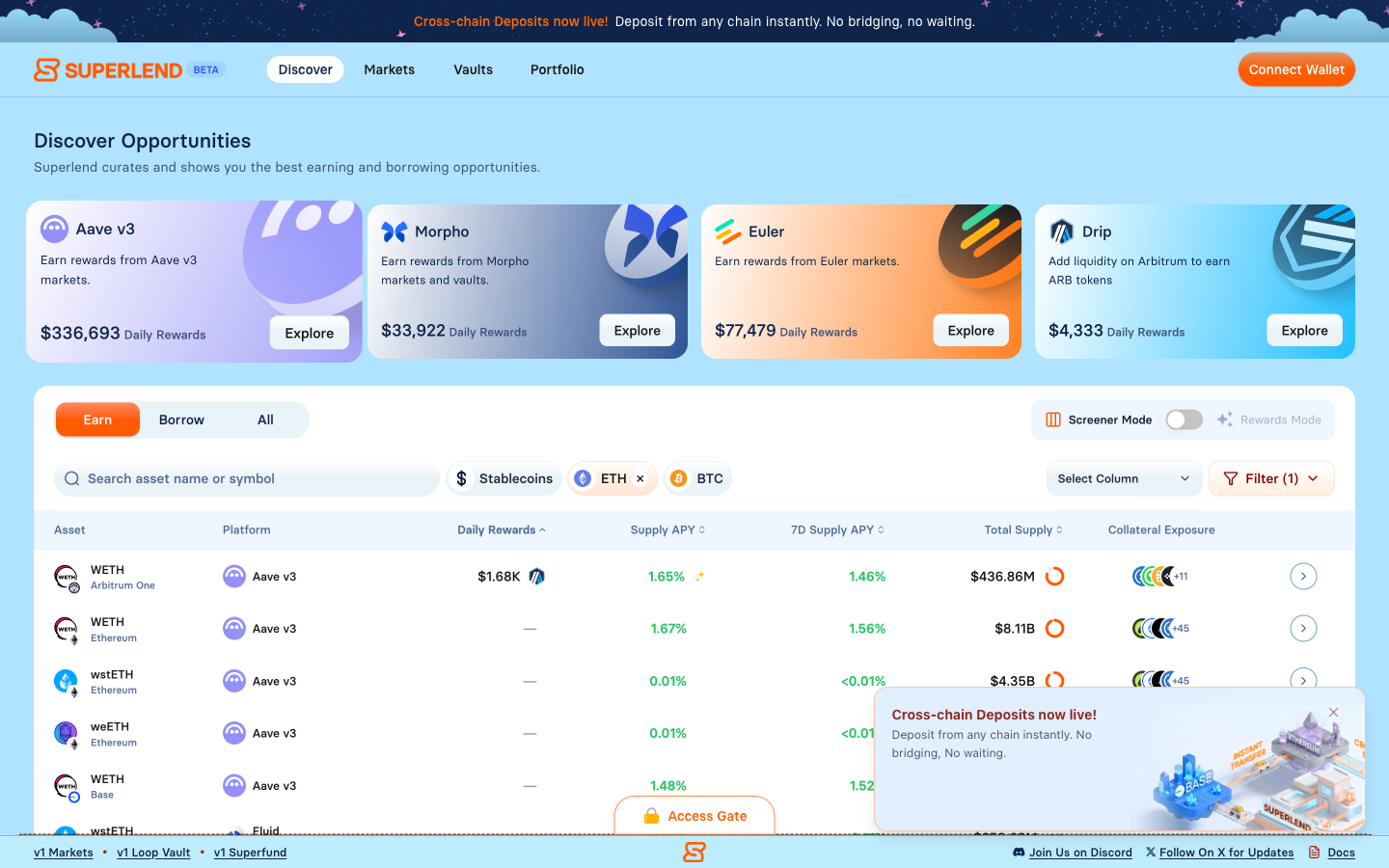 ETH and liquid staking token lending opportunities across protocols.
Stacking Yields: Staking + DeFi Strategies
The primary advantage of rETH comes from yield stacking – combining base staking returns with additional DeFi strategies for compounded returns.
Base Layer: Staking Rewards
rETH holders automatically earn Ethereum staking rewards, currently around 3-4% APY. These rewards accumulate through the token's increasing exchange rate against ETH, requiring no active management.
This passive yield forms the foundation for additional strategies. Every approach builds on top of this base staking income.
Strategy 1: Collateralized Borrowing Loop
Deposit rETH as collateral, borrow stablecoins, and deploy those stablecoins into yield opportunities. The math works when:
Stablecoin yield > Borrow cost
For example, if you borrow USDC at 5% APY and earn 8% in a stablecoin yield protocol, you capture 3% spread while maintaining rETH exposure and its 3-4% staking yield.
This strategy carries liquidation risk and requires active monitoring. Maintaining healthy collateral ratios becomes essential, especially during ETH price volatility.
Strategy 2: Liquidity Provision
Provide rETH/ETH liquidity on decentralized exchanges. Since both assets are highly correlated, impermanent loss risk stays minimal while earning trading fees.
DEX liquidity pools for LST pairs typically generate 1-5% additional APY depending on trading volume. Combined with underlying staking rewards, total returns can reach 5-9% during active trading periods.
Strategy 3: Recursive Borrowing
For sophisticated users, recursive strategies involve depositing rETH, borrowing ETH, swapping to rETH, and repeating. This amplifies staking exposure beyond initial capital.
Recursive positions increase capital efficiency but also amplify liquidation risk. A 10% drop in the rETH/ETH ratio could trigger cascading liquidations across leveraged positions.
Using rETH as Collateral for Borrowing
rETH serves as strong collateral across major DeFi protocols. Its consistent staking yield and high correlation to ETH make it attractive for both borrowers and protocol risk managers.
Collateral Parameters
Most protocols assign rETH similar parameters to ETH:
- Loan-to-value (LTV): 70-80% typically
- Liquidation threshold: 80-85%
- Liquidation penalty: 5-10%
These parameters enable capital-efficient borrowing while maintaining protocol solvency during market stress.
Borrowing Use Cases
Common reasons to borrow against rETH:
- Access liquidity without selling: Pay expenses or invest elsewhere while keeping staking exposure
- Tax efficiency: Borrowing isn't a taxable event in many jurisdictions
- Leverage long positions: Borrow stablecoins to buy more ETH or rETH
- Yield arbitrage: Borrow at low rates to deploy into higher-yielding opportunities
Managing Collateral Positions
Monitor the health factor of any collateralized position. The rETH/ETH exchange rate remains relatively stable, but ETH's USD price volatility affects positions borrowing stablecoins.
Set alerts for health factor thresholds and maintain buffers above liquidation levels. During high volatility periods, consider reducing leverage or adding collateral preemptively.
For a deeper understanding of lending mechanics, read our complete guide to DeFi lending.
Where to Find rETH Markets
rETH markets exist across multiple chains and protocols. Finding optimal rates requires comparing options across the ecosystem.
Ethereum Mainnet
The largest rETH markets operate on Ethereum L1:
- Aave V3: Primary rETH collateral market with deep liquidity
- Spark: MakerDAO's lending protocol supports rETH collateral
- Compound V3: Growing rETH support for collateral use
Mainnet offers the deepest liquidity but higher transaction costs. Larger positions benefit from mainnet's security and liquidity depth.
Layer 2 Networks
Arbitrum and Optimism host growing rETH markets:
- Lower transaction costs enable smaller position management
- Bridge considerations add complexity
- Liquidity remains thinner than mainnet
L2 markets suit active managers making frequent adjustments or users with smaller positions where mainnet gas costs become prohibitive.
Comparing Rates
Use Superlend to compare rETH opportunities across protocols. As a non-custodial DeFi lending aggregator, Superlend displays current rates without requiring deposits, enabling informed decisions before committing capital.
Rate comparison matters especially for borrowing. A 0.5% APY difference on a year-long position creates meaningful cost savings.
For comparison with standard ETH lending rates, see our analysis of ETH lending rates across major protocols.
Risks and Considerations
rETH strategies involve multiple risk layers requiring careful evaluation before deployment.
Smart Contract Risk
Every protocol interaction adds smart contract exposure. rETH itself relies on Rocket Pool's contracts, and each lending protocol or DEX introduces additional attack surface.
Mitigate by:
- Using battle-tested protocols with extensive audits
- Diversifying across protocols rather than concentrating
- Monitoring protocol security announcements
rETH Depeg Risk
While rETH should track its underlying value, market dynamics can cause temporary deviations. During high-demand periods or liquidity crunches, rETH might trade below fair value.
For collateral positions, significant depegs could trigger liquidations even when underlying value remains sound. Monitor rETH/ETH rates alongside USD prices when managing positions.
Slashing Risk
Rocket Pool node operators face slashing penalties for validator misbehavior. The protocol's insurance mechanisms and decentralized operator set minimize this risk, but it cannot be eliminated entirely.
Historical slashing rates across Ethereum remain extremely low, and Rocket Pool's design distributes any slashing impact across all rETH holders rather than concentrating on affected depositors.
Liquidation Risk
Leveraged positions face liquidation during adverse price movements. ETH volatility combined with any rETH depeg creates compounded risk for aggressive strategies.
Maintain conservative health factors and avoid maximum leverage. The yield difference between 2x and 3x leverage rarely justifies the additional liquidation risk.
Regulatory Uncertainty
Liquid staking tokens may face regulatory classification challenges. Some jurisdictions could treat LSTs as securities, affecting their availability or tax treatment.
Consider jurisdictional exposure when building significant LST positions.
For comprehensive risk analysis, read our guide on DeFi lending safety.
FAQ
What is the current rETH staking APY? rETH currently earns approximately 3-4% APY from Ethereum staking rewards. This rate fluctuates based on network activity, validator participation rates, and MEV rewards. The yield compounds automatically through the token's increasing exchange rate against ETH, requiring no claim transactions or manual harvesting.
Can I earn lending yield directly on rETH? Direct rETH supply yields remain limited compared to ETH or stablecoins. Most protocols use rETH primarily as collateral rather than creating active supply markets. When supply markets exist, APYs typically range from 0.5-2%. The primary yield opportunity comes from stacking strategies – using rETH as collateral to access capital for other yield-generating activities while continuing to earn base staking rewards.
How does rETH compare to running my own validator? Running a validator requires 32 ETH minimum and technical expertise for node operation. rETH provides exposure to staking rewards with any amount of capital and no hardware requirements. Solo validators earn higher gross returns (no protocol fees), but rETH offers instant liquidity, lower technical burden, and the ability to use staked assets as collateral. For most users, rETH's convenience and capital efficiency outweigh the approximately 10-15% fee on rewards taken by Rocket Pool.
Conclusion
rETH provides a foundation for sophisticated yield strategies combining Ethereum staking with DeFi lending opportunities. The token's decentralized architecture, value-accruing mechanism, and broad protocol support create flexibility for users ranging from passive holders to active yield farmers.
Base staking rewards around 3-4% APY require no active management. Adding collateral strategies, liquidity provision, or yield arbitrage can push total returns into the 5-8% range depending on market conditions and risk tolerance.
Success with rETH strategies requires understanding both the opportunities and risks. Smart contract exposure, depeg scenarios, and liquidation risk all demand attention. Conservative position sizing and diversified approaches provide better risk-adjusted outcomes than aggressive single-protocol strategies.
Explore current rETH markets through Superlend's discover page to compare rates across protocols and chains before deploying capital.
This guide is for informational purposes only and does not constitute financial advice. DeFi protocols carry inherent risks including smart contract vulnerabilities, liquidation risk, and potential loss of funds. Always conduct your own research and consider consulting with a financial advisor before making investment decisions.