
Finding the best yields in DeFi has never been more important – or more complex. With hundreds of lending markets spread across multiple chains and protocols, manually comparing rates is a full-time job. As of January 2026, the DeFi lending landscape continues to mature, offering a diverse range of opportunities for yield seekers.
This month, we are seeing interesting dynamics across the market. Stablecoin yields remain attractive as borrowing demand stays healthy, while ETH and BTC lending rates vary significantly depending on the protocol and chain you choose. Whether you are looking to earn passive income on your stablecoins, put your ETH to work, or find a home for your WBTC, this guide will help you navigate the options.
Superlend aggregates 350+ money markets across 11+ chains – compare rates across Aave, Compound, Morpho, and Euler from one dashboard.
Stablecoin Yields: January 2026
Stablecoins remain the bread and butter of DeFi lending. With their price stability, they offer a straightforward way to earn yield without exposure to crypto volatility. As of January 2026, stablecoin lending rates are showing healthy numbers across major protocols.
USDC Rates
USDC continues to be one of the most popular assets for DeFi lending. Rates vary depending on the protocol, chain, and current utilization levels. As of January 2026, you can expect to see USDC lending rates ranging from approximately 4% to 8% APY across major protocols. For a deep dive on USDC specifically, see our USDC lending guide.
The variance comes down to a few factors: Ethereum mainnet typically offers more competitive rates due to higher borrowing demand, while Layer 2 networks may offer different rates based on their unique ecosystem dynamics. Protocols with higher utilization tend to offer better rates, though this comes with slightly higher withdrawal risk during peak demand periods.
USDT Rates
Tether (USDT) lending rates generally track close to USDC, though you may notice slight differences based on market preferences. Some protocols have more USDT demand than others. As of January 2026, USDT rates are ranging from roughly 3.5% to 7.5% APY.
DAI Rates
MakerDAO's DAI remains a popular choice for DeFi natives who prefer a decentralized stablecoin. DAI lending rates as of January 2026 are typically in the 3% to 7% range, depending on the protocol and chain.
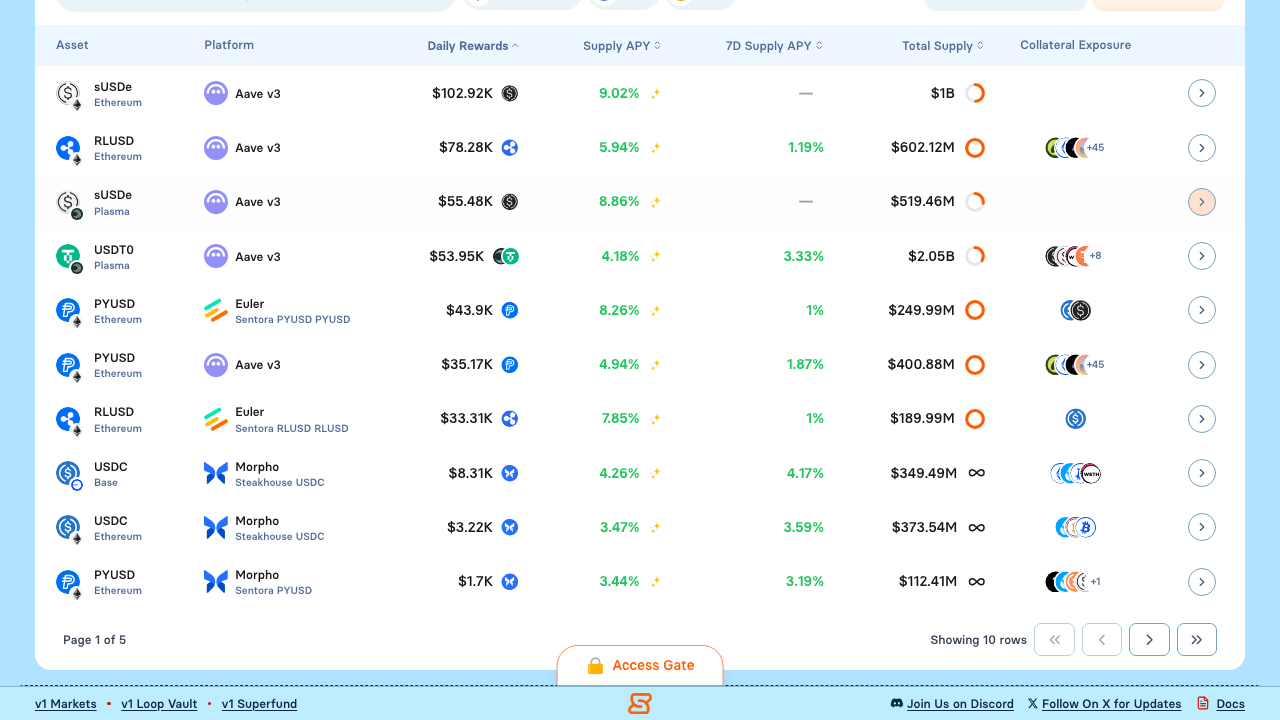 Current rates across all markets on Superlend
What Drives Stablecoin Rate Differences?
The spread between the low and high end of these ranges comes down to several factors:
- Utilization rate: Pools with higher borrowing demand pay lenders more
- Protocol: Different protocols have different interest rate models
- Chain: Ethereum mainnet often has higher rates than some L2s, but gas costs eat into returns
- Market conditions: Bull markets tend to increase stablecoin borrowing demand as traders leverage up
ETH Lending Rates: January 2026
Earning yield on ETH has evolved significantly with the rise of liquid staking. Today, you have several options: lend native ETH directly, or earn compounded yields through liquid staking tokens (LSTs) like stETH and rETH.
Native ETH Lending
Lending native ETH on protocols like Aave, Compound, and Morpho offers straightforward yields. As of January 2026, native ETH lending rates typically range from 1.5% to 4% APY. These rates fluctuate based on borrowing demand – when traders want to short ETH or use it for specific strategies, rates increase. For comprehensive ETH lending strategies, see our ETH lending rates guide.
Liquid Staking Token Yields
Liquid staking tokens offer an interesting alternative. By holding stETH (Lido) or rETH (Rocket Pool), you already earn the base Ethereum staking yield. But you can take this further by lending your LSTs on DeFi protocols, effectively stacking yields.
- stETH: Base staking yield plus potential lending yield
- rETH: Base staking yield plus potential lending yield
This strategy can bring total yields into the 4% to 7% range when combining staking rewards with lending rates.
ETH Lending Rate Comparison
ETH and liquid staking token lending rates change frequently based on market conditions. For current rates across all ETH-related lending opportunities, check Superlend's Discover page and filter by ETH or liquid staking tokens.
Considerations for ETH Lending
When choosing where to lend your ETH, consider:
- Gas costs: On Ethereum mainnet, transaction fees can significantly impact returns for smaller positions
- Lock-up periods: Native ETH lending typically has no lock-up, while staking withdrawals may have queues
- Smart contract risk: LSTs add an additional layer of smart contract risk on top of the lending protocol
BTC/WBTC Lending: January 2026
Bitcoin holders looking to earn yield in DeFi typically use Wrapped Bitcoin (WBTC) or other BTC derivatives. While DeFi offers more limited options for BTC compared to stablecoins or ETH, there are still opportunities worth exploring.
WBTC Lending Rates
WBTC lending rates as of January 2026 typically range from 0.5% to 3% APY. These rates are generally lower than stablecoin or ETH yields because borrowing demand for WBTC tends to be lower – most traders who want BTC exposure simply hold it rather than borrow it. For more on Bitcoin lending opportunities, see our WBTC lending guide.
Where to Find the Best BTC Yields
The best WBTC yields tend to appear on:
- Ethereum mainnet: Largest liquidity pools, most borrowing activity
- Newer protocols: Some emerging protocols offer boosted yields to attract liquidity
- Specific chains: Certain L2s or alternative chains may have higher BTC borrowing demand
BTC Lending Comparison
WBTC and other Bitcoin derivative lending rates vary by protocol and market conditions. For current BTC lending opportunities across all supported protocols, visit Superlend's Discover page and filter by BTC.
Risk Considerations for BTC Lending
BTC lending in DeFi carries some unique considerations:
- Wrapper risk: WBTC relies on custodians to hold the underlying BTC. Understand who backs the wrapped version you're using.
- Lower liquidity: BTC markets on some protocols may have less depth than stablecoin or ETH markets
- Opportunity cost: Consider whether the yield justifies the complexity versus simply holding BTC
Top Protocols for Yield: January 2026
With so many lending protocols available, choosing where to deposit can feel overwhelming. Here is a breakdown of the major players and what they offer as of January 2026.
Aave
Aave remains the largest DeFi lending protocol with $25B+ in TVL. That scale means deep liquidity – your deposits earn competitive rates without moving markets, and you can withdraw large amounts without slippage. It offers:
- Multi-chain presence: Ethereum, Arbitrum, Optimism, Polygon, Avalanche, and more
- Wide asset selection: Stablecoins, ETH, WBTC, and various altcoins
- Safety modules: Protocol-owned insurance mechanisms
- Proven track record: Years of operation without major exploits
Aave is often the go-to choice for users prioritizing security and liquidity, even if rates are not always the absolute highest.
Compound
Compound pioneered algorithmic interest rates and remains a solid option:
- Simplicity: Straightforward interface and mechanics
- Ethereum-focused: Primary liquidity on mainnet
- Compound III: Newer version with improved capital efficiency
- Established protocol: Long track record in the space
Compound tends to attract users who value simplicity and a proven model.
Morpho
Morpho has emerged as an innovative player that optimizes existing lending markets:
- Rate optimization: Matches lenders and borrowers for better rates
- Built on top of Aave and Compound: Leverages existing liquidity
- Higher yields: Often offers improved rates through its matching mechanism
- Growing adoption: Increasing TVL and user base
Morpho is worth considering if you want to potentially earn more than base protocol rates.
Euler
Euler offers a permissionless lending market with some unique features:
- Permissionless listing: More assets available than curated protocols
- Advanced risk management: Sophisticated oracle and liquidation mechanisms
- Higher yields on niche assets: Long-tail tokens often have better rates
- Active development: Regular updates and improvements
Euler appeals to users willing to explore beyond the most common assets.
Protocol Comparison Summary
Current rates across all markets on Superlend
How to Find the Best Rates
With so many protocols, chains, and assets, finding the best rates manually would require checking dozens of interfaces daily. Here are practical approaches to optimize your yield hunting.
Using Superlend to Compare 350+ Markets
Superlend aggregates rates from over 350 money markets across 11+ chains, giving you a single dashboard to compare opportunities. Instead of manually checking Aave, Compound, Morpho, and others individually, you can:
- See real-time rates across all major protocols
- Filter by asset, chain, and protocol
- Compare total returns including any incentive rewards
- Execute deposits directly through the interface
This saves hours of research and helps ensure you are not missing better opportunities hidden on less-visible protocols or chains.
Beyond APY: What Else to Consider
Raw APY numbers do not tell the whole story. When evaluating where to deposit, also consider:
- Gas costs: A 2% higher yield on Ethereum mainnet may not be worth it if gas costs eat half your returns on a small position
- Utilization rate: Very high utilization (over 85%) means higher rates but potential withdrawal delays
- Protocol risk: Newer or less-audited protocols may offer higher rates to attract liquidity – understand why before chasing yield
- Liquidity depth: Ensure you can withdraw your position without significant slippage
- Chain risk: Each chain has its own security profile and bridge dependencies
Rate Hunting Best Practices
- Set a minimum yield threshold: Do not move funds for tiny improvements
- Factor in gas costs: Calculate your break-even period before switching
- Diversify across protocols: Do not put all your assets in one place
- Monitor utilization: High utilization today may normalize tomorrow
- Check audit status: Stick to audited protocols with track records
SuperFund: Automated Yield Optimization
If manually hunting for yields sounds like too much work, SuperFund offers an automated alternative. Available in the Vaults section on Superlend, SuperFund vaults automatically optimize your stablecoin deposits across multiple lending opportunities.
How SuperFund Helps
SuperFund handles the complexity of yield optimization:
- Automatic rebalancing: Vaults move funds to capture better rates
- Gas-efficient: Shared gas costs across all depositors
- Diversified exposure: Deposits spread across multiple protocols
- Single deposit: One transaction to access optimized yields
For users who want yield without the daily management, SuperFund offers a hands-off approach to DeFi lending.
Who SuperFund Is For
SuperFund works well for:
- Stablecoin holders who want passive income
- Users without time for daily rate monitoring
- Smaller positions where gas costs make manual optimization impractical
- Anyone who prefers automated strategies over active management
Frequently Asked Questions
What is a realistic DeFi yield to expect in January 2026?
Realistic stablecoin yields currently range from 4% to 8% APY depending on the protocol and market conditions. ETH yields are typically 1.5% to 4% for native ETH lending, or 4% to 7% when including liquid staking rewards. These rates are variable and change based on supply and demand. Be cautious of any protocol promising significantly higher returns – extremely high yields often indicate higher risk or unsustainable incentive programs.
Is it safe to lend crypto in DeFi?
DeFi lending carries inherent risks including smart contract vulnerabilities, oracle failures, and liquidity risks. However, major protocols like Aave and Compound have operated for years with strong security records and multiple audits. To manage risk, consider using established protocols, diversifying across multiple platforms, and never depositing more than you can afford to lose. Understanding what you are depositing into is always the first step.
How often do DeFi lending rates change?
DeFi lending rates change constantly – sometimes by the minute. Rates are algorithmically set based on real-time supply and demand in each lending pool. When borrowing demand increases, rates go up to attract more lenders. When borrowing slows, rates decrease. This is why comparing rates across protocols at any single moment only gives you a snapshot. Tools like Superlend help track these changes across multiple markets simultaneously.
Conclusion
January 2026 offers solid yield opportunities across DeFi for stablecoin, ETH, and BTC holders. While rates vary significantly by protocol, chain, and market conditions, patient yield hunters can find attractive returns by comparing options and understanding the trade-offs involved.
For stablecoin holders, current yields in the 4% to 8% range represent a meaningful way to earn passive income. ETH holders can stack staking yields with lending for combined returns. And while BTC yields remain more modest, opportunities exist for those willing to explore.
The key is having the right tools and information to make informed decisions. Whether you prefer hands-on rate hunting through Superlend or automated optimization via the Vaults section, the infrastructure exists to help you earn more on your crypto holdings.
For more background on how DeFi lending works, check out our Complete Guide to DeFi Lending, Understanding Lending Protocols, and Is DeFi Lending Safe.
Rates shown are as of January 2026 and are variable. Past performance does not guarantee future results. This is not financial advice. DeFi involves risks including smart contract vulnerabilities and potential loss of funds. Always conduct your own research before making investment decisions.